


Table of Contents
Introduction
Most people picture retirement as something that happens at 65, if it happens at all. But a growing number of Americans are asking a different question: what if I didn’t wait that long? That’s the idea behind the FIRE movement — Financial Independence, Retire Early — and it starts with one simple tool: a FIRE calculator.
The concept isn’t new. It traces back to the 1992 book Your Money or Your Life, which reframed spending as “hours of life energy” rather than dollars. Decades later, blogs and online communities turned that idea into a full movement, and today’s FIRE calculator is the modern version of the spreadsheets early adopters built by hand.
If you’ve typed “how much do I need to retire early” into Google, you’ve probably landed on a dozen different retirement savings calculators, each with its own formulas and assumptions. This guide cuts through the noise. You’ll learn how a fire calculator works, how to calculate your FIRE number by hand, how Barista FIRE and Coast FIRE fit into the picture, and the parts of early retirement planning — taxes, healthcare, market risk — that most calculators skip entirely.
What Is a FIRE Calculator?
A FIRE calculator is a tool that estimates the investment portfolio you need to cover your living expenses indefinitely, without relying on a traditional job. Instead of asking “will I have enough at 65,” it asks a sharper question: at what dollar amount can my investments sustain me forever?
Unlike a generic simple retirement calculator, a fire retirement calculator usually factors in:
- Your current savings and investments
- Your annual spending (not income)
- Expected investment returns and inflation
- A safe withdrawal rate, typically 3.5% to 4%
The output is your “FIRE number” — the nest egg you’d need to stop working for money altogether.
The Four Types of FIRE (and Their Formulas)
Before running any numbers, it helps to know which flavor of FIRE you’re actually aiming for, since each uses a different expense multiplier:
Lean FIRE
For a minimalist retirement with tightly controlled spending. Formula: Annual Expenses × 20 (roughly a 5% withdrawal rate). Someone spending $30,000/year would need about $600,000.
FIRE (the standard 4% Rule)
The most common target, based on the Trinity Study. Formula: Annual Expenses × 25.
Fat FIRE
For a more comfortable, higher-spending retirement with a bigger safety margin. Formula: Annual Expenses × 33 to 50, depending on how conservative you want to be.
Coast FIRE
Covered in detail below — this is the amount you need right now so that growth alone gets you to full FIRE by a target age, even with zero future contributions.
How to Calculate Your FIRE Number
The core formula behind almost every FIRE calculator is refreshingly simple:
FIRE Number = Annual Expenses ÷ Safe Withdrawal Rate
Using the classic 4% rule:
FIRE Number = Annual Expenses × 25
A Quick Example
Say your household spends $50,000 a year:
$50,000 × 25 = $1,250,000
That’s your target portfolio. Some people prefer a more conservative 3.5% withdrawal rate (roughly 28.5x expenses) if they plan to retire very early and want a bigger cushion against bad market years.
Real-World Example: Meeting Your FIRE Number
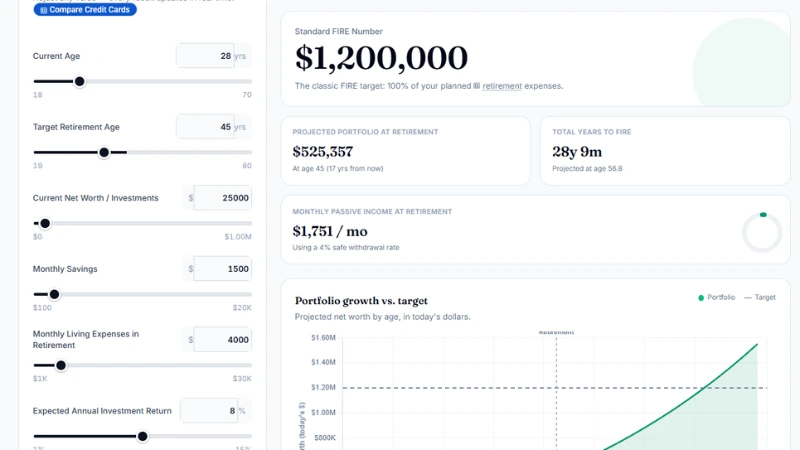
Consider Alex, a 34-year-old software developer who spends $48,000 a year. Alex’s FIRE number at a 4% withdrawal rate is $1,200,000. By saving 55% of a $110,000 salary and investing it in low-cost index funds, Alex builds a $200,000 portfolio by 34. Assuming a 7% average annual return and continued contributions, that portfolio crosses $1.2 million by roughly age 47 — well ahead of a traditional retirement timeline. The exact math is what a FIRE calculator automates instantly, but Alex’s example shows how savings rate, not income, drives the timeline.
How to Calculate Your Coast FIRE Number
Coast FIRE is the point at which your current investments, left untouched, will grow to your full FIRE number by a target retirement age — even if you never save another dollar again.
Coast FIRE Number = FIRE Number ÷ (1 + Return Rate)^Years Until Retirement
For example, if your FIRE number is $1,250,000, you’re 35, plan to retire at 65 (30 years), and expect a 7% average annual return:
$1,250,000 ÷ (1.07)^30 ≈ $164,300
Once your portfolio hits roughly $164,300, you’ve technically “coasted” — you could stop contributing entirely and still reach your FIRE number by 65 through growth alone. Many people at this stage keep working but shift to lower-stress, lower-paying jobs since the retirement math is already handled.
Benefits: lower financial pressure, more flexibility to change careers, and a more sustainable savings pace than aggressive FIRE. Trade-offs: it requires disciplined saving early on, and it still depends on future market returns matching your assumptions — a prolonged downturn can push your timeline back.
Barista FIRE Calculator: A Middle-Ground Option
A Barista FIRE calculator addresses a different scenario: leaving a demanding career for part-time or lower-stress work — often just enough to cover health insurance and daily expenses — while your investments keep compounding toward full retirement.
To estimate your Barista FIRE number:
- Calculate your full FIRE number (annual expenses × 25)
- Subtract the portion of expenses your part-time income will cover
- Apply the 25x (or your chosen) multiplier to the remaining amount
If your annual expenses are $50,000 and part-time work covers $20,000, your portfolio only needs to generate $30,000 annually: $30,000 ÷ 0.04 = $750,000 — a much smaller target than the full $1.25 million.
Sequence of Returns Risk: The Thing Most Calculators Don’t Explain
Here’s a scenario most basic calculators gloss over: two people can retire with the exact same average return over 30 years and end up with very different outcomes, depending on when the bad years happen.
If the stock market drops sharply in your first few years of retirement, you’re forced to sell investments at depressed prices to cover expenses — leaving less money to recover when the market rebounds. This is called sequence of returns risk, and it’s one reason many FIRE planners hold 1–3 years of expenses in cash or bonds heading into retirement, so they’re not forced to sell stocks during a downturn.
Tax-Advantaged Ways to Access Money Before 59½
One question a fire financial independence retire early plan has to answer that a normal retirement plan doesn’t: how do you access retirement accounts before the standard withdrawal age without triggering the 10% early withdrawal penalty? A few common strategies:
- Roth Conversion Ladder — Convert traditional 401(k)/IRA funds to a Roth IRA gradually, then withdraw the converted principal (not earnings) tax- and penalty-free after a 5-year waiting period per conversion.
- Rule of 55 — If you leave a job in or after the year you turn 55, you can withdraw from that employer’s 401(k) penalty-free (though income tax still applies).
- 72(t) / SEPP (Substantially Equal Periodic Payments) — Allows penalty-free withdrawals from IRAs at any age, as long as you take a fixed, calculated distribution annually for at least 5 years or until age 59½, whichever is longer.
These aren’t strategies to attempt without professional guidance, but knowing they exist changes how you structure savings between taxable brokerage accounts, Roth accounts, and traditional retirement accounts as you build toward FIRE.
Planning for Healthcare Before Medicare
Healthcare is the single biggest wildcard for early retirees, since Medicare eligibility doesn’t start until 65. Options typically include:
- ACA marketplace plans — Premium subsidies are based on income, so many early retirees intentionally keep reported income low (a benefit of living off principal or Roth withdrawals) to qualify for larger subsidies.
- HSA (Health Savings Account) — Contributions are tax-deductible, growth is tax-free, and withdrawals for medical expenses are tax-free at any age, making it one of the most efficient healthcare-funding vehicles available.
- COBRA continuation coverage — Temporary, often expensive, but useful as a short-term bridge immediately after leaving a job.
Skipping this step is one of the most common — and most expensive — mistakes in early retirement planning.
Building the Investment Portfolio Behind Your FIRE Number
A FIRE calculator’s output is only as good as the return assumptions behind it, which depend on how your money is actually invested:
- Stocks/ETFs — Typically the largest allocation for anyone more than 10 years from their target date, given their higher historical long-term returns.
- Bonds/fixed income — Adds stability and reduces sequence of returns risk as retirement approaches.
- Cash — A smaller buffer (often 1–3 years of expenses) to avoid selling investments during a downturn.
Don’t ignore investment fees. Even a 1% annual expense ratio can quietly erode a portfolio by tens of thousands of dollars over a 20-30 year horizon — low-cost index funds (often under 0.10%–0.20%) are the standard choice among FIRE planners for this reason.
Choosing the Right FIRE Calculator Tool
| Tool | Best For | Notable Feature |
|---|---|---|
| Simple FIRE calculator | A quick, single-page estimate | Minimal inputs, fast results |
| FIRE calculator Excel template | Full customization | Model taxes, multiple income streams, custom inflation |
| NerdWallet’s FIRE calculator | Beginners | Clean interface, blends FIRE with standard retirement planning |
| Walletburst’s FIRE calculator | Detailed projections | Year-by-year breakdown, Coast FIRE view |
| FIRE calculator Europe versions | Non-US savers | Adjusts for euro/pound currency, local pension systems, and different tax treatment than 401(k)/IRA accounts |
If you’re saving in USD, look for a FIRE calculator USD version that reflects 401(k)/IRA contribution limits and US tax brackets — a European-based tool may use different default assumptions around pensions and withdrawal taxation that won’t match a US retirement account structure.
Common Mistakes When Using a FIRE Calculator
- Underestimating future expenses, especially healthcare before Medicare eligibility.
- Ignoring taxes. Withdrawals from traditional 401(k)s and IRAs are taxed as income; Roth withdrawals are not.
- Using overly optimistic return assumptions. Most planners use 6–7% real (inflation-adjusted) returns rather than raw historical stock averages.
- Forgetting inflation entirely, which erodes purchasing power over a multi-decade retirement.
- Not accounting for sequence of returns risk in the first few years after retiring.
Frequently Asked Questions
What is a good FIRE number for someone earning $70,000 a year? It depends on spending, not income. Someone spending $40,000 annually needs a FIRE number of $1,000,000 (25x); someone spending $55,000 needs $1,375,000.
How is Coast FIRE different from regular FIRE? Regular FIRE means you have enough invested right now to cover full retirement. Coast FIRE means your current investments, left alone to grow, will reach that number by a target age — so you can stop saving but keep working.
Can I retire early with $500,000? Yes, particularly through Barista FIRE, Coast FIRE, or in a lower cost-of-living area. At a 4% withdrawal rate, $500,000 supports about $20,000 in annual withdrawals.
Do FIRE calculators account for Social Security? Most basic calculators don’t. Many FIRE planners exclude it entirely to build in a safety margin, since eligibility age and benefit amounts can change over time.
How do I access retirement savings before age 59½ without a penalty? Common approaches include a Roth conversion ladder, the Rule of 55 (for employer plans left at 55+), and 72(t)/SEPP distributions from IRAs — each with specific rules worth reviewing with a tax professional.
Is the 4% rule still accurate today? It remains a widely used starting point, though many planners now favor a more conservative 3.5% withdrawal rate for those retiring in their 30s or 40s, given longer withdrawal horizons.
Final Thoughts: Start Running Your Numbers
A FIRE calculator won’t guarantee an exact retirement date, but it turns an abstract goal into a concrete target you can plan around. Whether you’re aiming for full financial independence, a Coast FIRE milestone, or a Barista FIRE lifestyle, the math starts the same way: know your expenses, pick a withdrawal rate, and work backward — then layer in the tax and healthcare strategy that most calculators leave out.
Start by plugging your own numbers into a simple FIRE calculator today. Even a rough estimate can reshape how you save, spend, and think about the years ahead.
