


Table of Contents
Key takeaways
- A coast FIRE calculator shows how much you need invested today to reach your FIRE number through growth alone.
- Your FIRE number is usually yearly retirement spending × 25, which assumes a 4% withdrawal rate.
- At age 35 with a 6% real return, the coast number is about $174,100 for a $1 million FIRE target, $261,200 for $1.5 million and $435,300 for $2.5 million.
- If you are below your coast number, you can close the gap by investing more, retiring later or planning to spend less.
- Test lower returns before you stop contributing. Every result is an estimate, not a promise.
A coast FIRE calculator shows how much you need invested today so your portfolio can grow to your retirement target without further contributions. TheGlobalNext, a personal finance site covering FIRE, saving and investing, wrote this guide with three worked examples, Lean, Traditional and Fat FIRE, so you can see how the answer changes with your spending.
New to the formula? Our coast FIRE number guide explains it step by step. To find your own FIRE number first, try our FIRE calculator.
How a Coast FIRE Calculator Works
A coast FIRE calculator discounts your FIRE number back to today at an assumed real return, then compares the result with your current balance. The formula is:
Coast FIRE number = FIRE number ÷ (1 + real return)^years to retirement
A real return is the return after inflation, so your spending should be in today’s money too. If your invested balance is above the result, the model says growth alone can reach your target. If it is below, the difference is your gap.
How to Calculate Your FIRE Number
To calculate your FIRE number, multiply the amount you expect to spend each year in retirement by 25. This is often called the rule of 25, and both Bankrate and NerdWallet explain it.
The Rule of 25
The number 25 is simply 1 divided by 0.04, the 4% withdrawal rate. ChooseFI gives a clear example: spending of $60,000 a year gives a FIRE number of $1.5 million. Start by tracking what you really spend today. Our budgeting and saving guides can help.
Adjusting for Healthcare Costs
The rule of 25 treats all spending the same, but healthcare can take a bigger share in retirement. GOBankingRates quotes a retirement planner who suggests multiplying non-health spending by 28, which is roughly a 3.5% withdrawal rate, and health insurance costs by 40, then keeping a cash buffer.
Here is an illustration of that approach. Suppose you spend $60,000 a year, including $8,000 on health insurance. That gives 28 × $52,000 + 40 × $8,000 = $1.776 million, compared with $1.5 million from the basic rule. At 6% over 30 years, your coast number rises from about $261,200 to about $309,200. This is one planner’s more cautious view, not a standard rule.
Three Coast FIRE Calculator Examples
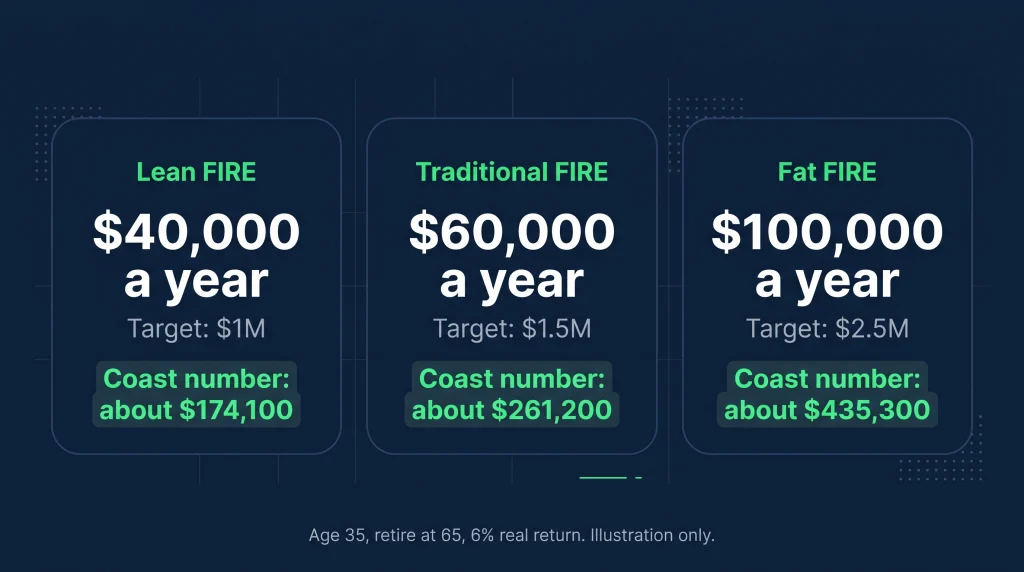
Each example assumes you are 35, plan to retire at 65 (30 years away) and use real returns with spending in today’s dollars. Labels such as Lean and Fat have no official definition. ChooseFI places Lean FIRE under $40,000 of yearly spending and Fat FIRE at $100,000 or more, and a Nasdaq beginner’s guide describes Fat FIRE as covering a higher standard of living.
Lean FIRE: $40,000 a Year
Your FIRE number is $1 million. At a 6% real return, your coast number is about $174,100. The target is the smallest of the three, but it leaves less margin for error if your costs rise.
Traditional FIRE: $60,000 a Year
Your FIRE number is $1.5 million. At 6%, your coast number is about $261,200. This is the middle case and matches the example in our coast FIRE number guide.
Fat FIRE: $100,000 a Year
Your FIRE number is $2.5 million. At 6%, your coast number is about $435,300. You need a bigger pot today, but you keep a more comfortable lifestyle.
The table shows all three at different returns. These are our own illustrations, rounded to the nearest $100.
| Goal | FIRE number | Coast number at 5% real | At 6% real | At 7% real |
|---|---|---|---|---|
| Lean FIRE ($40,000) | $1,000,000 | $231,400 | $174,100 | $131,400 |
| Traditional FIRE ($60,000) | $1,500,000 | $347,100 | $261,200 | $197,100 |
| Fat FIRE ($100,000) | $2,500,000 | $578,400 | $435,300 | $328,400 |
One pattern holds in every row: dropping from a 6% to a 5% return raises the coast number by about a third. The return you assume matters as much as the lifestyle you choose.
What If You Are Below Your Coast Number?
If your balance is below your coast number, you have three levers: invest more, retire later or spend less. Here is the Traditional example with a $150,000 balance, which is about 57% of the $261,200 needed.
- Invest more. Suppose you want to coast by age 45. The coast number at 45 is about $467,700, and your $150,000 would grow to roughly $268,600 over 10 years at 6%. Closing the gap takes about $15,100 a year, or about $1,260 a month, assuming end-of-year contributions.
- Retire later. Retiring at 67 gives 32 years of growth, which lowers the coast number at 35 to about $232,000.
- Spend less. Planning for $50,000 a year gives a $1.25 million FIRE number and a coast number of about $217,600.
Use your FIRE calculator to test how each change moves your target.
Stress-Testing Your Result
A coast FIRE calculator uses one steady return, but real markets rise and fall. ChooseFI advises that if you are close to your number at 7%, you should test 5% or 6% before you stop contributing.
The withdrawal rate also matters. Kiplinger reports that Morningstar puts the highest safe starting rate for US retirees in 2026 at 3.9%. At that rate, $60,000 of spending needs about $1.54 million instead of $1.5 million, and your coast number rises by about 2.6%.
To learn how risk and return interact over decades, see our investing guides.
Coast FIRE Calculator Mistakes to Avoid
- Mixing real and nominal numbers. Use real returns with spending in today’s money.
- Trusting one return. Run at least two or three rates.
- Forgetting healthcare and taxes. Your retirement costs are uncertain, so build in a margin.
- Treating the number as a quit-work number. Coasting means you still cover your living costs until retirement.
- Picking a lifestyle label first. Start from what you really expect to spend, not from Lean or Fat.
Coast FIRE Calculator FAQs
How do you calculate your FIRE number?
Multiply your expected yearly retirement spending by 25. If you expect to spend $60,000 a year, your FIRE number is $1.5 million. For a more cautious figure, consider healthcare costs separately, as shown above.
How do you calculate your coast FIRE number?
Divide your FIRE number by (1 + real return) raised to the number of years until retirement. For example, $1.5 million over 30 years at 6% gives about $261,200. Our full coast FIRE number guide walks through each step.
Is Lean FIRE or Fat FIRE easier to coast to?
Lean FIRE needs the smaller pot, so it is faster to reach, but it leaves less room for rising costs. Fat FIRE needs a larger pot but gives you more cushion. Which is easier depends on what you really plan to spend.
How accurate is a coast FIRE calculator?
A coast FIRE calculator is only as accurate as its assumptions. It uses a constant return, while markets are uneven, so treat the result as a planning range and test lower returns.
Conclusion
A coast FIRE calculator turns your retirement target into a number you can track today. Start with your FIRE number, apply the formula at a few returns, then compare the result with your balance and decide whether to invest more, retire later or spend less.
Ready to try it yourself? Open our FIRE calculator to find your FIRE number, then browse our FIRE and retirement guides for the next step.
This article is for general information and education only. It is not personal financial, tax or legal advice. Your situation is different, so consider speaking to a qualified adviser before you act.
